Choosing Granular Tomato Fertilizer requires more than comparing the three numbers on a bag. Tomato plants need balanced nutrition, steady moisture, and careful timing. A fertilizer that looks powerful may encourage leaves while reducing fruit quality. That assumption deserves challenge.
FAO’s World Food and Agriculture Statistical Yearbook 2024 reports approximately 185 million tonnes of fertilizer nutrients were used globally in 2022. This scale highlights a serious issue: efficiency matters, not just volume. Mordor Intelligence’s 2025 fertilizer market assessment also identifies nutrient-use efficiency and controlled release as important purchasing trends. These reports do not determine the perfect tomato formula. They provide useful context for evaluating nitrogen, phosphorus, potassium, release speed, and application waste.
Dr. George Hochmuth, a recognized University of Florida nutrient-management specialist, offers a practical warning: “More fertilizer is not always better.” Buyers should remember that sentence beside every product label. A granular product with moderate nitrogen may outperform a stronger formula when soil already contains sufficient nutrients. Soil-test results, tomato variety, planting stage, and local rainfall should guide the decision. Granules should dissolve evenly, avoid dusty handling, and remain easy to measure around each plant. A small scoop beside a young tomato can reveal poor judgment quickly.
This guide examines label accuracy, nutrient ratios, coating technology, application timing, and supplier reliability. It also questions common buying habits, because the cheapest bag may create hidden costs through runoff, weak roots, or uneven fruiting.
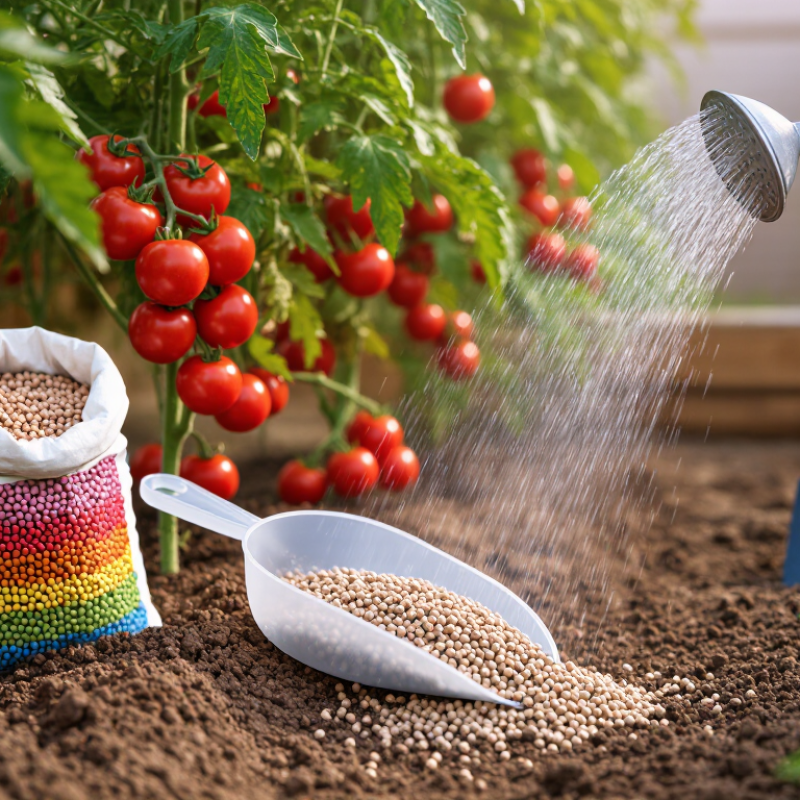
Granular tomato fertilizer is a dry mixture of plant nutrients formed into small, solid particles. Each granule usually contains nitrogen, phosphorus, and potassium, often called NPK. Some products also provide calcium, magnesium, or trace minerals. These nutrients support leafy growth, strong roots, flowering, and fruit development.
Granules work when moisture dissolves their nutrients into the soil. Plant roots then absorb the nutrients with water. Fast-release granules can act within days, while coated or slow-release granules feed plants over several weeks. The difference matters. A tomato plant beside a sunny wall may dry quickly and need more frequent watering. Wet soil can delay nutrient movement and increase root stress.
Buyers should check the NPK ratio, release period, and application rate. A soil test is more reliable than guessing from leaf color. Too much nitrogen may produce tall, dark foliage but fewer tomatoes. I have seen this happen in containers after one generous feeding. It looked healthy at first. It was not.
Choose granules suited to tomatoes and the growing method, whether soil beds, raised beds, or containers. Granule size should spread evenly around the root zone. Keep fertilizer away from the stem, then water thoroughly. This reduces the risk of salt injury. Calcium deserves attention when soil tests show a deficiency, but adding it alone may not solve blossom-end rot. Irregular watering is often the real problem.
Choosing granular tomato fertilizer starts with crop stage, not bag appearance. Tomato roots need modest nitrogen after transplanting, but excess nitrogen produces leaves and delays fruiting. University of Florida IFAS guidance reports that harvested tomatoes remove roughly 5 pounds of nitrogen, 1 pound of P2O5, and 8 pounds of K2O per 1,000 pounds of fruit. These figures are useful benchmarks, not automatic application rates. Soil texture, irrigation, and previous manure change the calculation.
During establishment, choose a balanced granular formula with phosphorus only when soil tests show a need. Phosphorus supports roots, yet excess phosphorus can accumulate. From flowering through fruit set, nitrogen demand increases steadily. Potassium becomes more important for fruit filling, firmness, and water regulation. The International Fertilizer Association’s 4R guidance supports the right source, rate, time, and placement. Split applications reduce losses, especially in sandy beds. Keep fertilizer several centimeters from stems.
During heavy fruit enlargement, buyers should favor moderate nitrogen and stronger potassium, then compare the guaranteed analysis. USDA NRCS Standard 590 emphasizes soil testing and nutrient budgeting before rate decisions. Slow-release granules may reduce feeding mistakes, but they cannot fix compacted soil or poor irrigation. Growers often see lush plants underperform after generous feeding. That is the uncomfortable lesson. Recheck leaves, fruit size, and soil moisture weekly. If growth looks dark and soft, reduce nitrogen before adding more fertilizer.
Which nutrients tomato plants need at each growth stage
The chart shows the relative nutrient demand of tomato plants at four common growth stages. Nitrogen supports early leaf and stem development, phosphorus is especially important for root establishment and flowering, while potassium demand increases during fruit set, fruit enlargement, and ripening. Buyers should select granular fertilizers according to the crop stage rather than using the same NPK ratio throughout the season.
Matching fertilizer to soil and plant conditions is more reliable than choosing the highest nutrient numbers. Start with a soil test. It should show pH, available phosphorus, potassium, and organic matter. Tomatoes usually perform well in slightly acidic soil, around pH 6.0 to 6.8. Sandy soil loses nutrients quickly, so a controlled-release granular fertilizer can reduce repeated applications. Clay soil holds nutrients longer but may need compost to improve drainage. Wet roots cannot use fertilizer efficiently.
Plant growth also changes the formula you need. Young transplants benefit from moderate nitrogen and balanced phosphorus. Too much nitrogen can produce tall, dark leaves with few flowers. During flowering and fruit development, tomatoes generally need more potassium, while excessive phosphorus may be unnecessary in already fertile soil. Calcium matters too, but adding it blindly may disturb soil balance. Read the guaranteed analysis and application rate carefully.
Observe the plants weekly. Pale lower leaves can suggest nitrogen shortage, yet yellow leaves may also reflect poor drainage. I have seen growers blame fertilizer when compacted soil caused the problem. A small test area is wiser than treating every bed at once. This is not a perfect formula. Weather, irrigation, and previous compost applications can change results. Adjust slowly, keep records, and ask a qualified soil specialist when test results conflict with plant symptoms.
How to Choose Granular Tomato Fertilizer for Buyers?
Granule size affects spreading accuracy and nutrient uniformity. For field tomatoes, choose particles with a narrow size range, not dusty powder. A practical target is 2–4 millimeters for many broadcast spreaders. Smaller granules dissolve quickly but may drift or cake. Larger granules can spread unevenly across narrow beds. The International Fertilizer Association reported global fertilizer demand near 205 million tonnes of nutrients in 2024/25. That scale makes physical quality control increasingly important for buyers.
Release rate should match irrigation, soil texture, and crop growth. Quick-release nitrogen can support early leaf growth, but excess nitrogen may produce soft plants and delayed fruiting. Controlled-release granules reduce repeated applications, although their performance changes with temperature and moisture. USDA NRCS Nutrient Management Standard 590 emphasizes matching nutrient timing and placement with crop demand. Ask suppliers for release curves, coating details, laboratory data, and storage stability. Marketing claims alone are weak evidence.
Application method changes the buying decision. Use uniform granules for broadcast spreading, finer grades for shallow incorporation, and larger particles for band placement. Keep fertilizer away from direct root contact; tomato roots can suffer salt injury. Check spreader calibration with a tray test. Small errors matter. I have seen a visually consistent batch spread poorly after humidity exposure. Buyers should inspect sieve analysis, caking resistance, nutrient analysis, and application instructions before approving a shipment. Even a reliable specification needs field verification.
| Fertilizer Profile | Typical Granule Size | Typical Nutrient Format | Typical Release Rate | Best Application Method | Suitable Tomato Stage | Main Advantages | Buyer Considerations |
|---|---|---|---|---|---|---|---|
| Fine soluble granules | Approximately 0.5–2 mm | Fully water-soluble NPK; often supplied as a concentrated fertilizer for dilution | Fast: nutrients become available after dissolving | Mix with irrigation water or apply as a carefully diluted soil drench | Transplant establishment, rapid vegetative growth, and periods of visible nutrient deficiency | Fast nutrient availability; easy to adjust concentration; suitable for fertigation | Requires accurate dilution and uniform irrigation; over-application can increase salt stress |
| Standard quick-release granular NPK | Approximately 2–4 mm | Dry compound or blended NPK; commonly includes readily available nitrogen, phosphorus, and potassium | Fast to moderate: commonly available over several days to a few weeks, depending on moisture and temperature | Broadcast and incorporate into the soil before planting, or place in a band away from direct root contact | Pre-plant fertilization and early growth | Simple handling; generally economical; provides a quick nutrient supply | Uniform granule size helps improve spreading accuracy; avoid placing concentrated granules against stems or roots |
| Balanced granular tomato fertilizer | Approximately 2–5 mm | Complete NPK with secondary nutrients or micronutrients, depending on the soil program | Moderate: often supplies nutrients over several weeks when soil moisture is adequate | Apply in a shallow ring around the plant or in a side-dress band, then water thoroughly | Vegetative growth through early flowering | Provides a broad nutrient profile for general production; convenient for routine feeding | Check the guaranteed analysis and soil-test results to avoid unnecessary phosphorus or micronutrient buildup |
| High-potassium granular formula | Approximately 2–5 mm | Higher potassium proportion relative to nitrogen; may include calcium, magnesium, or sulfur | Moderate: depends on the nutrient salts, granule structure, and soil moisture | Side-dress along the crop row or apply in a ring during flowering and fruit development | Flowering, fruit set, fruit filling, and harvest periods | Supports a nutrient program that emphasizes potassium during fruit production | Potassium does not replace nitrogen, calcium, or magnesium; excessive potassium may interfere with magnesium or calcium uptake |
| Coated controlled-release granules | Approximately 2–4 mm | Granules enclosed by a polymer or other coating that controls nutrient diffusion | Slow and controlled: commonly designed for several weeks to several months; actual timing varies with temperature and moisture | Incorporate into the root-zone soil or place below the surface according to the product directions | Container production, greenhouse crops, and situations requiring fewer applications | Can reduce application frequency and nutrient-loss risk when properly matched to crop duration | Release is affected by temperature; select a release period that matches the tomato production cycle |
| Organic or natural-source granules | Approximately 2–6 mm; may include irregular particles | Plant-, animal-, or mineral-derived nutrients; nitrogen release depends partly on microbial activity | Slow to moderate: strongly influenced by temperature, moisture, soil biology, and material composition | Blend into the soil before planting or apply as a surface side-dress and water in | Pre-plant soil preparation and long-season feeding | Often provides organic matter or gradual nutrient release, depending on the material | Guaranteed nutrient content can vary; verify analysis, maturity, salinity, odor, and pathogen-management information |
| Micronutrient-enriched granular fertilizer | Approximately 1–4 mm | NPK supplemented with selected nutrients such as boron, iron, zinc, or manganese | Moderate or variable: depends on the carrier and whether the micronutrients are soluble, incorporated, or coated | Apply uniformly to the soil or use in a band only when a soil or tissue test supports the need | Any stage where a confirmed micronutrient deficiency exists | May correct specific deficiencies without requiring several separate products | Micronutrients are needed in small amounts; confirm the target nutrient and application rate before purchase |
| Large prilled or compacted granules | Approximately 4–6 mm | Dry granular NPK or single-nutrient fertilizer with larger, denser particles | Moderate to slow dissolution compared with finer particles, depending on composition and coating | Mechanical spreading, pre-plant incorporation, or carefully measured side-dressing | Field-grown tomatoes where application efficiency and reduced dust are priorities | Lower dust potential; suitable for bulk handling and mechanical application | Check spreader compatibility and segregation risk; larger particles may distribute unevenly at low application rates |
Buyer note: Granule size alone does not determine fertilizer performance. Compare the guaranteed nutrient analysis, release mechanism, moisture requirements, application rate, particle uniformity, and compatibility with the intended irrigation and soil-management system. Release timing is approximate and can change with temperature, moisture, soil type, and product formulation.
Choosing granular tomato fertilizer starts with safety, not bright packaging or the lowest price.
Check the guaranteed analysis, ingredient list, batch number, and directions for use. A soil test helps match nitrogen, phosphorus, potassium, calcium, and magnesium to actual field needs. Avoid products with unclear sources or exaggerated harvest claims. Local rules matter. Request contaminant testing, especially for heavy metals, where required.
For effective feeding, select granules that dissolve steadily and suit your irrigation and soil texture.
Water movement matters. Large granules may feed unevenly, while dusty material can drift during handling. Look for consistent size, low moisture, and sealed packaging.
Tomatoes need balanced nutrition, but excessive nitrogen can create soft growth and delay fruiting. A small trial strip is safer than treating an entire crop. Record leaf color, stem strength, flowering, and fruit quality each week.
Cost should be measured per usable nutrient, not per bag.
Compare the price of supplied nitrogen and potassium, then include freight, application labor, and storage losses. Some fertilizers cost less but require repeated applications. Others appear efficient yet perform poorly in cold or compacted soil. That uncertainty deserves attention. Ask for independent quality documentation when available, and keep purchase records for traceability. I would not ignore a modest product trial; field results can challenge a confident spreadsheet.
(Your form has been submitted.)
We'll be in touch soon! Until then, take a look around — you never know what you'll find!